Feb 26 books
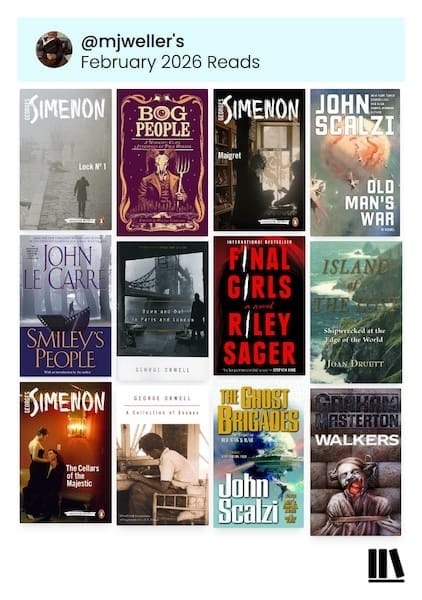
One of the features I like in Storygraph since resurrecting my account is the addition of monthly wrap-ups. The image is my cover collage for last month (Feb 2026).
I read 12 books this month, which is about average. I'm working my way through all of the Maigret books (I completed the collection of all 77 novels/short stories last month, so there's the usual two or three of these. I could write a lot about Simenon and Maigret, but for horror fiction there are two relevant take-aways I think. Firstly, it is usually unremittingly bleak. Everyone's life is miserable, and even when Maigret wraps up the case, he doesn't feel any elation (sometimes he doesn't even bother to0 arrest the criminal). This unflinching, unromantic view of humanity can make Stephen King seem like light relief. Secondly, his style is clipped, shorn of needless adjectives, adverbs and similes. "Throw out all the literary stuff" was the advice from his editor.
Sometimes horror fiction suffers from overly florid language, and writers might do well to cast a Simenon eye over their work. Yes, I speak for myself here.
In January I read, or re-read, most of the George Smiley novels. Le Carré had probably read his fair share of Simenon, and has a similar unromantic view of humanity. This month I re-read some Orwell, namely Down and Out in London and Paris, and the Collected Essays. I'll confess I abandoned Burmese Days. I remembered why it depressed me so much first time around, the unrelenting racism, casual cruelty and pettiness of British colonial life may be brilliantly portrayed, but I didn't have the stamina for it.
For enjoyment and escape (which, God knows, has been needed this month as we stumble drunkenly to world war 3), I read a couple of John Scalzi's Old Man's War series. Scalzi is adept at taking an idea and working through the practical and social implications of it. In this case it is people over the age of 75 being offered rejuvenation into new bodies to fight in colonial space wars. But it can be anything - see for example, what if the moon turned to actual cheese? I have a fancy that he chucks a load of random ideas in a top hat and pulls one out and goes "ok, what would that be like?" It's probably not a bad idea to test your writing muscles.
Finally (!) onto the horror books I read last month. Final Girls by Riley Sager. The Final Girl trope, as identified by Carol Glover in her outstanding book, Men, Women and Chainsaws, has passed peak recognition now, and is a bit tired. There are at least four novels with this theme. Of these I preferred Grady Hendrix's Final Girl Support Group. Sager is a fine writer but one always gets the sense that he veers away from actual horror to more thriller convention. Give me the horror, goddammit! Stephen Graham Jones Indian Lake trilogy probably does the best meta-fiction around final girls and also gives us one for the ages in Jade Daniels. One final word on final girls - my favourite was Amy Steel in Friday the 13th part 2. We should have had more Amy Steel movies.

Graham Masterton's 1989 novel Walkers takes the concept of a haunted asylum in a different direction, with druidic rites, ley lines and people living in walls. My favourite horror read of the month was an anthology - Bog People. I love folk horror, but what made this particularly enthralling was the working class focus. Horror, and particularly folk and gothic horror, has always been a vehicle fro exploring issues of class. As editor Hollie Starling writes in the Introduction "the genre gives anthropomorphic voice to an earth assumed to be inert. It grants magical powers to the most downtrodden, wretched and witch-hunted. It finds the uncanny in the clash between different socio-economic worlds". The stories aren't always explicitly about class but it does play a role in how each tale pans out.
My second novel focuses on a group of academics, at least one of whom is working class, and it's been interesting to work through how this identity frames their reaction to the horror element. Like gender and race, horror can be a powerful lens to examine some of these tensions.